
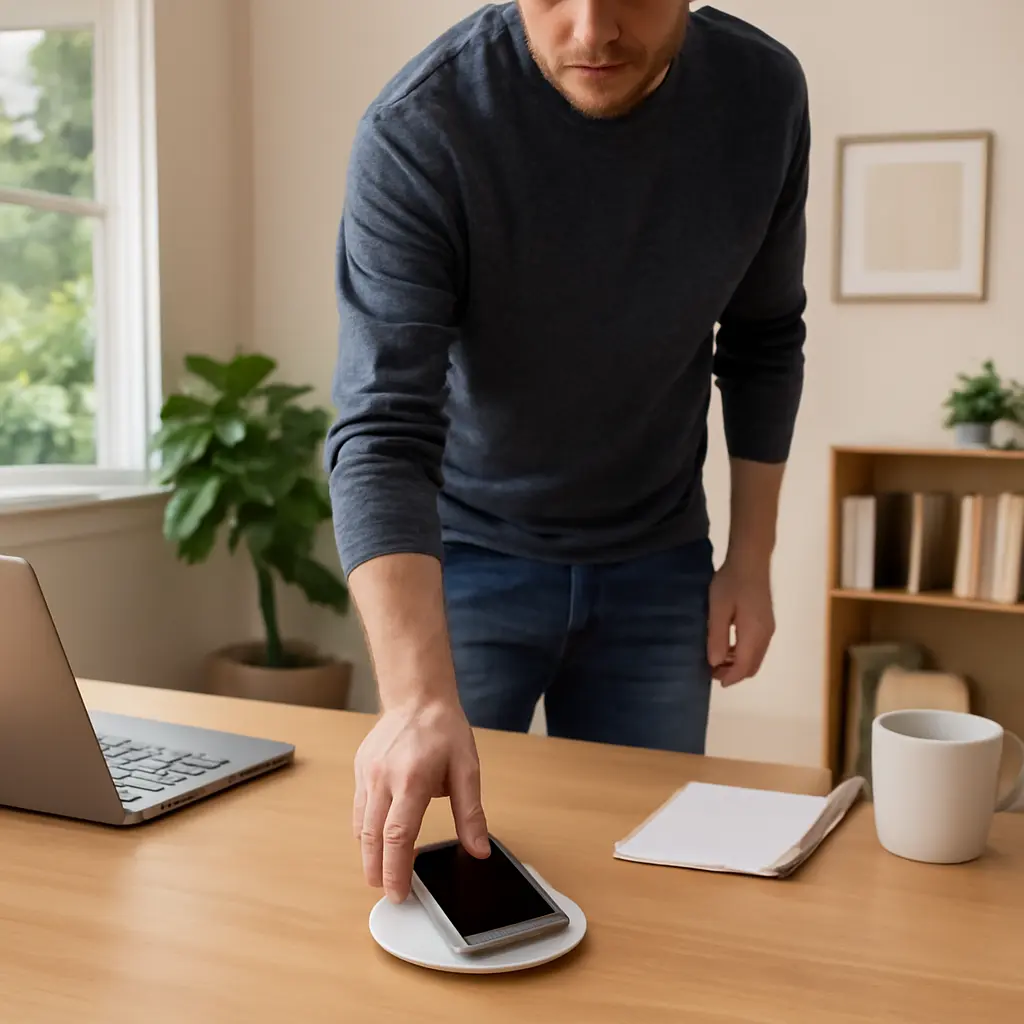
Qi wireless charging is a standardized way to transfer power over a short distance from a charging pad to a compatible device. For a practical starting point, look for the Wireless Power Consortium’s Qi certification rather than relying on the phrase “wireless charging” alone: certification signals that a product has been tested against the relevant Qi requirements for safety, interoperability, and performance. The essentials are how Qi works, what the Qi and Qi2 generations mean, how to choose and use a charger, and what the standard does—and does not—guarantee.
Qi wireless charging standards define interoperability
The Wireless Power Consortium (WPC), the industry organization that develops the Qi specification, describes Qi as an interface standard for wireless power transfer. In everyday use, a Qi charger and a Qi-compatible receiver communicate and transfer energy through closely aligned coils. The standard’s purpose is to make products from different manufacturers work together within specified limits, rather than requiring a unique charging system for each device brand.
Qi is an example of inductive power transfer: the charger’s coil creates a changing magnetic field, and a coil in the receiving device converts that field into electrical power. This is near-field charging, not room-scale wireless electricity. The device generally needs to sit on or very close to the charging surface, and placement affects how reliably power transfers.
The WPC introduced the first Qi specification in 2008. Its later development has included broader power capabilities, device communication, foreign-object detection, and magnetic alignment features. The WPC has reported more than 13,000 Qi-certified products over the standard’s history; because the product directory changes, consumers should check the current WPC database for a particular model rather than treating any historical total as a current count.
Qi certification and compatibility
Qi certification means a product has been tested through the WPC’s certification process for conformance to the applicable specification. It is a more useful compatibility signal than a seller’s unqualified claim that a charger is “Qi-compatible.” Certification does not mean every phone charges at the same speed: the receiving device, charger, power adapter, alignment, temperature, and software can all affect actual performance.
Hyponyms and product categories within the Qi ecosystem include Qi-certified charging pads, stands, multi-device chargers, and receivers built into phones or accessories. A Qi-certified pad may charge a compatible device, but it cannot add wireless charging capability to a phone that lacks a Qi receiver. For a reliable purchase, check both the charger and the device in the WPC product database and confirm the manufacturer’s stated charging limits.
Inductive transfer, alignment, and power
Inductive charging depends on magnetic coupling between transmitter and receiver coils. The closer and better aligned the coils are, the more effectively energy can pass between them. This explains why a device may charge slowly or not at all when it is off-center, separated by an unsuitable case, or placed on a charger that does not support its required operating mode.
Power ratings describe capability, not a promise of constant charging speed. The WPC’s Qi2 specification launched with a 15-watt profile, while Qi2 25W adds a higher-power option for products that support it. A 25-watt charger will not make a device charge at 25 watts unless that device and the charging system negotiate and support the corresponding profile. Actual battery charging also slows as a battery approaches full charge and may be limited to manage heat.
Qi2 adds magnetic alignment to Qi charging
Qi2 is a generation of the Qi standard that uses the Magnetic Power Profile (MPP), a magnetic alignment system designed to position the charger and receiver coils consistently. The WPC announced Qi2 in 2023, drawing on technology associated with Apple’s MagSafe system. Magnetic alignment can make placement easier and help maintain the coil position needed for efficient charging, especially with compatible phones and accessories.
Qi2 certification is distinct from simply having magnets. A magnetic accessory or charger is not automatically a certified Qi2 product, and Qi2 support depends on the exact device and charger models. The WPC’s newer Qi2 25W profile raises the supported power level compared with the original Qi2 profile; consumers should verify the certification mark and the manufacturer’s specifications to determine which profile a product uses.
Magnetic Power Profile and device positioning
The Magnetic Power Profile uses magnets to guide the receiver into a repeatable position over the transmitter. This is useful because poor coil alignment can reduce power transfer and increase energy losses that become heat. The practical benefit is simpler placement, but magnetic alignment does not eliminate the need for compatible hardware, nor does it guarantee a particular charging speed in every circumstance.
Qi2 products may include phones, charging stands, pads, and magnetic accessories. Compatibility is profile-specific: a product may support Qi charging without supporting Qi2’s magnetic alignment, while a Qi2-certified charger can still operate with some older Qi devices according to the applicable supported mode. Check the device maker’s compatibility information before assuming magnets or a Qi logo indicate full Qi2 functionality.
Qi2 25W and the meaning of wattage
Qi2 25W is a higher-power profile in the Qi2 family. The figure refers to a maximum supported wireless power level under the standard’s conditions, not a guaranteed rate from the wall outlet into a phone battery. Charger electronics, the USB power supply, device support, thermal management, and charging state all influence the power delivered in practice.
When comparing products, distinguish the charger’s advertised output from the phone’s supported wireless input. Also check whether the bundled wall adapter can supply the charger’s required input. A charger labeled for a high output but paired with an underpowered adapter may not reach its advertised capability.
Safe and effective Qi charging depends on setup
Qi charging is designed to manage power transfer between a transmitter and receiver, but good setup still matters. The WPC specification includes communication and safety-related provisions such as foreign-object detection, which helps identify metal objects that could heat during charging. Users should nevertheless follow product instructions and remove coins, keys, or other metal items from the charging area.
Heat, cases, and foreign objects
Wireless charging produces heat because power conversion and magnetic transfer are not perfectly efficient. A warm device can be normal, but excessive heat may cause a phone or charger to reduce power or stop charging. Thick cases, metal components, misalignment, and high ambient temperatures can worsen performance. If a device becomes unusually hot, stop charging, remove the case if appropriate, and consult the manufacturer’s guidance.
Foreign-object detection is intended to reduce the risk of heating from conductive objects between the charging coils. It is a safety feature, not a reason to leave objects on a pad or ignore warnings. Use a charger from a reputable manufacturer, keep its surface clear, and avoid damaged cables, adapters, or charging equipment.
Choosing a charger and checking certification
A practical selection process starts with the device, not the charger’s largest wattage claim. Confirm that the phone supports Qi or Qi2, identify its maximum supported wireless power and any magnetic-alignment requirements, then choose a certified charger and a suitable power adapter. Check the WPC’s online product database for the exact model number; product names can be similar, and certification applies to specific product models.
- Confirm the phone or accessory supports the charging standard and profile you want.
- Verify the charger’s exact model and certification status in the WPC directory.
- Check the charger’s required power adapter and cable specifications.
- Place the device centrally, keep metal objects clear, and follow the device maker’s thermal and case guidance.
Conclusion: start with compatibility, then compare performance
Qi is the foundational wireless charging interface standard; certification helps establish interoperability, while inductive transfer explains why close placement and alignment matter. Qi2 adds magnetic alignment through the Magnetic Power Profile, and Qi2 25W provides a higher-power option for supported products. Across all generations, wattage is a capability rather than a guaranteed charging speed, and safe operation depends on compatible equipment, a suitable adapter, clear charging surfaces, and sensible heat management.
Before buying, verify the exact device and charger models in the WPC directory and consult their manufacturers’ specifications. For further reading, begin with the WPC’s Qi and Qi2 standard information and its certified-product database, then compare those details with your device maker’s support documentation.
Sources: Wireless Power Consortium, Qi Wireless Charging, https://www.wirelesspowerconsortium.com/qi/; Wireless Power Consortium, Qi2, https://www.wirelesspowerconsortium.com/qi2/; Wireless Power Consortium, Qi Certified Product Database, https://www.wirelesspowerconsortium.com/products/; Wireless Power Consortium, “Wireless Power Consortium Announces Qi2,” 2023, https://www.wirelesspowerconsortium.com/newsroom/; Apple, “How to wirelessly charge your iPhone,” https://support.apple.com/en-us/108377.


