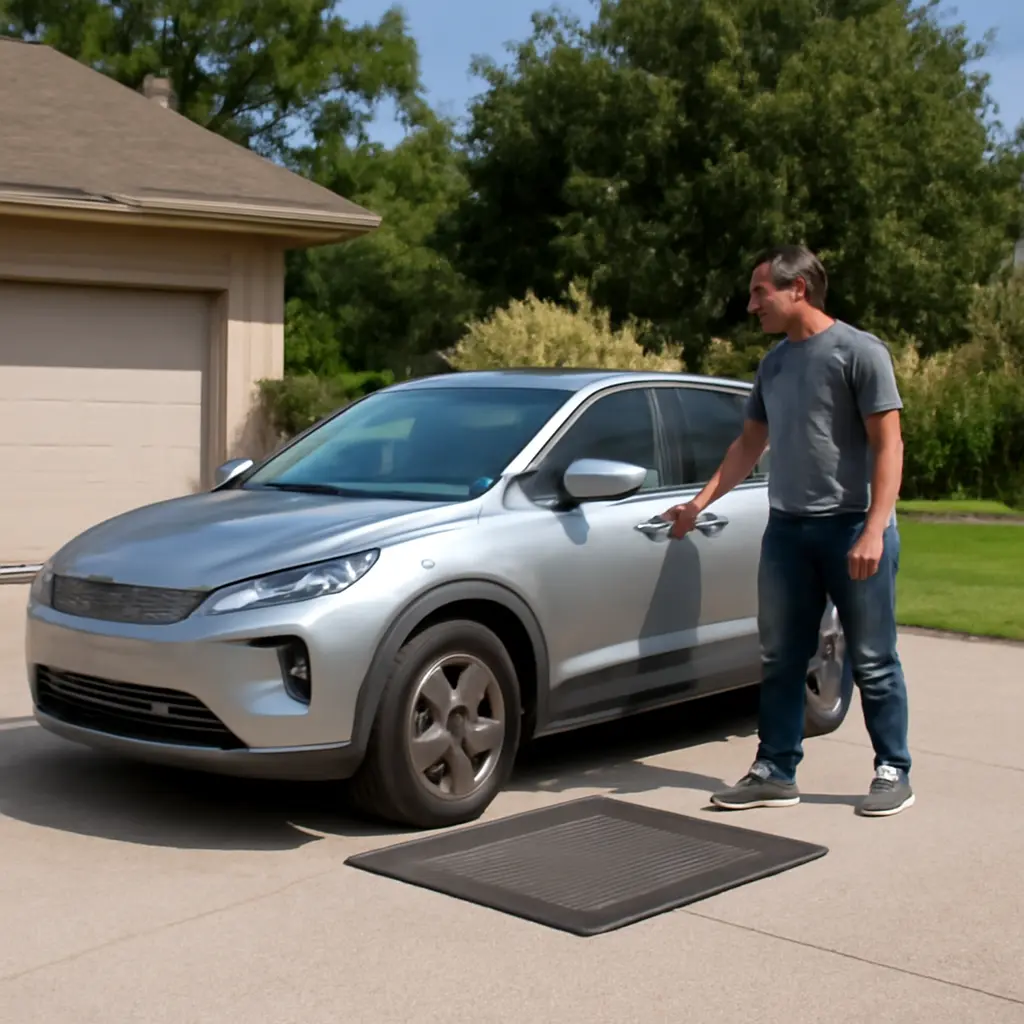
Inductive charging efficiency describes how much electricity reaches a vehicle’s battery compared with how much is drawn from the power source. It can make charging more convenient, but the headline efficiency figure does not tell the whole story: results depend on where the measurement begins and ends, how well the vehicle is aligned, the air gap, charging power, temperature, and energy use while the system waits. Tests of wireless electric-vehicle charging have reported efficiency in the same broad range as many plug-in systems under favorable conditions, but real-world losses and standby consumption matter. This article explains what efficiency figures mean, what affects them, how wireless charging compares with cables, and what drivers should check before buying.
Inductive charging efficiency and the vehicle charging chain
Inductive charging transfers energy between coils without a conductive plug. A stationary primary coil, usually installed in a ground pad, creates a changing magnetic field; a secondary coil beneath the vehicle receives energy and power electronics convert it into a form the battery can use. The Society of Automotive Engineers (SAE) defines requirements for light-duty plug-in electric-vehicle wireless power transfer in SAE J2954, including interoperability, safety, and performance testing. Efficiency is not a single universal property of “wireless charging”: it is a ratio that depends on the system boundary and operating conditions.
The distinction matters because a reported coil-to-coil result excludes losses that occur in the vehicle’s inverter, rectifier, cabling, and battery-charging electronics. A grid-to-battery measurement includes more of those stages and is the more useful comparison for estimating electricity costs. The U.S. Department of Energy’s Alternative Fuels Data Center describes Level 2 AC charging as commonly operating around 90% efficiency, while laboratory and industry demonstrations of vehicle wireless charging have reported efficiencies in a similar general range when alignment and operating conditions are favorable. These values should not be treated as directly comparable unless the test boundaries and methods match.
Grid-to-battery versus coil-to-coil efficiency
Grid-to-battery efficiency is the portion of electricity entering the charging equipment that is stored in the battery. Coil-to-coil efficiency measures energy transferred from the transmitter coil to the receiver coil, leaving out upstream conversion and downstream charging losses. A high coil-to-coil figure can therefore coexist with a lower overall result. When reviewing a product claim, look for the measurement boundary, test power, vehicle position, battery state of charge, and whether cooling or standby loads are included.
Wireless charging power classes
Wireless charging systems are commonly grouped by power level. SAE J2954 addresses stationary light-duty systems, including power classes up to 11 kW; standards work and demonstrations also explore higher-power applications. Power class affects charge time, thermal conditions, and the amount of energy processed by the conversion electronics. It does not, by itself, guarantee a particular efficiency: a well-matched lower-power system can outperform a poorly aligned or lightly loaded higher-power system.
Factors that change inductive charging efficiency
The core engineering challenge is transferring power across an air gap while keeping the transmitter and receiver coils properly coupled. Losses can arise from magnetic leakage, electrical resistance, power conversion, and auxiliary equipment. SAE J2954 establishes alignment and interoperability procedures because the relative position of the pads is central to reliable performance. In practice, efficiency varies with the vehicle, charger, installation, and charging session—not merely with the technology label.
Alignment and air gap
Alignment describes how closely the vehicle’s receiver coil sits over the ground transmitter coil; the air gap is the physical separation between them. Greater lateral offset or separation weakens magnetic coupling and can increase losses or reduce power. Vehicle height, suspension configuration, parking position, and pad installation all influence the gap and alignment. Positioning aids can help drivers park accurately, but buyers should ask how the system performs across its permitted alignment range rather than relying only on a best-case demonstration.
Power electronics and thermal management
Both the ground unit and vehicle convert electrical power, and every conversion stage produces some loss, much of it as heat. Coil materials, switching components, frequency control, and cooling design affect performance. Charging at high power can increase thermal demands, while operation at very low power may make fixed auxiliary loads a larger fraction of the total. The U.S. Department of Energy’s vehicle-charging research emphasizes that charging infrastructure must manage power conversion, communications, safety, and thermal conditions as an integrated system.
Standby consumption and charging duration
A wireless pad may consume electricity while waiting for a vehicle, communicating with it, or maintaining readiness. Even modest standby draw can accumulate when the vehicle is parked for long periods, particularly if charging sessions are infrequent. The relevant measure is energy over time, not just peak transfer efficiency. Ask manufacturers or installers for idle-power figures and whether the system enters a low-power sleep mode when no vehicle is present.
Inductive charging efficiency compared with plug-in charging
A wired charger generally avoids the extra air-gap transfer stage, which gives it a straightforward efficiency advantage in many comparisons. But the size of that advantage depends on measurement boundaries and equipment. The U.S. Department of Energy’s Alternative Fuels Data Center gives approximately 90% as a typical efficiency reference for Level 2 charging; wireless-system results can approach that territory in controlled conditions, though vehicle-specific, grid-to-battery testing is needed for a fair comparison. No single percentage applies to every car or charging installation.
Convenience is not the same as energy efficiency
Wireless charging can reduce handling: a driver parks over a pad rather than connecting a cable. That convenience may be valuable for fleets, accessible parking, automated parking, and drivers who charge at home every day. It does not mean the system uses less electricity. For an efficiency comparison, measure kilowatt-hours taken from the wall against kilowatt-hours delivered to the battery under the same vehicle, temperature, state-of-charge range, and charging power.
A practical energy-cost example
Suppose a vehicle stores 20 kWh in its battery during a session. At 90% grid-to-battery efficiency, the wall supplies about 22.2 kWh; at 85%, it supplies about 23.5 kWh. The difference is roughly 1.3 kWh per session, before accounting for standby energy. Multiply that gap by the number of charging sessions and the local electricity rate to estimate annual cost. This is an illustrative calculation, not a performance claim for a particular product.
Safety, interoperability, and real-world deployment
Efficiency is only one part of a usable charging system. Wireless equipment must also manage foreign objects, people and animals near the pad, communications between vehicle and charger, electromagnetic exposure, and reliable power transfer. SAE J2954 provides a framework for interoperability and safety testing, while standards development helps ensure that compatible vehicles and ground assemblies can work together. Compatibility should be confirmed for the exact vehicle and charger model rather than assumed from the presence of an induction pad.
Home and fleet use cases
At home, wireless charging is most compelling when repeated plug-in steps are a burden and the parking position is consistent. Fleets may benefit more when vehicles return to the same bays on predictable schedules, allowing automated charging and reducing driver labor. Transit and commercial pilots have also examined opportunity charging, in which vehicles receive energy at stops or depots. These applications must weigh installation expense, utilization, maintenance, and energy losses alongside convenience.
What to ask before choosing a system
- What is the measured grid-to-battery efficiency, and what test standard and boundary were used?
- How does efficiency change with realistic parking offsets, vehicle ride height, and charging power?
- What is the charger’s standby power when no vehicle is charging?
- Is the specific vehicle and charging pad combination certified or otherwise validated for interoperability?
- What are installation, service, and replacement costs compared with a cable-based Level 2 charger?
- Does the quoted efficiency include cooling, communications, and other auxiliary energy?
Conclusion: interpret inductive charging efficiency as a system result
Inductive charging efficiency is shaped by the full path from the electrical grid to the battery, not just by the magnetic link between pads. Alignment, air gap, conversion electronics, heat, charging power, and standby consumption all influence how much energy is actually stored. Wireless systems can deliver convenient charging and, under favorable conditions, reach efficiency levels in the broad range of plug-in charging—but headline figures are meaningful only when their test boundaries and conditions are clear. Before choosing a system, compare grid-to-battery data, confirm vehicle compatibility, and include installation and idle-energy costs in the decision. For further reading, consult SAE J2954 and the U.S. Department of Energy’s Alternative Fuels Data Center guidance on charging efficiency.
Sources: SAE International, SAE J2954_202408: Wireless Power Transfer for Light-Duty Plug-in/Electric Vehicles and Alignment Methodology, https://www.sae.org/standards/content/j2954_202408/; U.S. Department of Energy, Alternative Fuels Data Center, Electric Vehicle Charging Infrastructure, https://afdc.energy.gov/fuels/electricity_infrastructure.html; U.S. Department of Energy, Vehicle Technologies Office, Wireless Charging, https://www.energy.gov/eere/vehicles/wireless-charging