Wearable wireless charging is the transfer of power to a device without plugging a cable into the device itself. The upgrade wearables need is not simply “more wireless charging,” but charging that is easier to align, safer and more consistent across small devices. The Wireless Power Consortium’s Qi2 standard adds magnetic alignment to compatible phone charging, while wearables still rely on a mix of proprietary docks, pucks and contact-based charging. That gap matters as wrist-worn devices become everyday health and communication tools: this guide explains the technologies, their practical trade-offs, the standards challenge and what buyers can do now.
Wireless charging defines the wearable convenience gap
Wireless charging transfers energy between a power transmitter and a receiver without a direct cable connection to the device. The Wireless Power Consortium (WPC), which maintains the Qi specification, describes inductive charging as power transfer through magnetic fields between coils. In many wearables, however, “wireless” means that the watch rests on a dedicated charging puck or cradle: the user avoids inserting a plug into the watch, but still needs the right accessory and a reliable position.
That distinction helps explain why wireless charging can feel seamless on a phone yet fiddly on a watch. Wearables have limited internal volume, small batteries and curved or water-resistant cases. Their charging interfaces must fit those constraints while managing heat and maintaining alignment. A magnetic puck is a practical solution, but it is not automatically universal: watch makers may use different coil layouts, magnets, charging protocols and accessories.
Inductive charging: the common foundation
Inductive charging uses electromagnetic induction: alternating current in a transmitter coil creates a changing magnetic field, which induces current in a receiver coil inside the wearable. The watch’s electronics convert that energy to charge the battery. This approach supports a sealed device exterior, an advantage for products designed to resist sweat and water, but efficient transfer depends on how closely and accurately the coils are positioned.
The Qi family is the best-known consumer inductive-charging standard, particularly for phones and accessories. A WPC announcement for Qi2 introduced magnetic alignment through the Magnetic Power Profile, drawing on Apple’s contribution of its MagSafe technology. Qi2’s initial 15-watt power profile was designed to improve alignment and charging performance for compatible products. Those developments are relevant to wearables, but Qi or Qi2 support in a phone does not mean a watch can charge on the same pad: the watch must itself support a compatible receiver and charging profile.
Magnetic pucks and proprietary docks
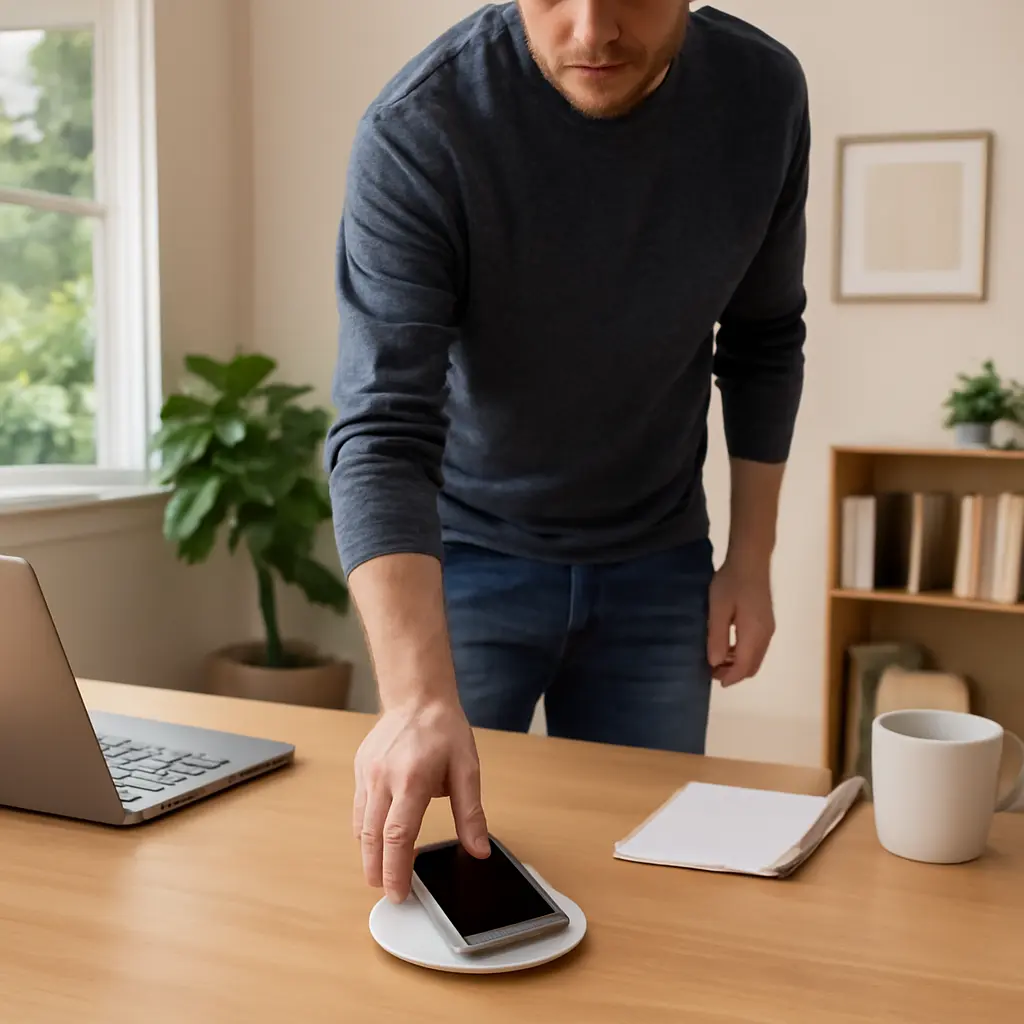
A magnetic puck is a small charging accessory that uses magnets to guide a wearable into a repeatable position over its charging contacts or coil. It reduces the need to plug a cable into the watch and can make overnight charging straightforward. Apple Watch, for example, uses a magnetic charging cable or dock; Samsung Galaxy Watch models also use model-compatible wireless charging accessories. These are real-world examples of convenient alignment, but they do not establish a universal cross-brand standard.
A dock can also add stability and provide a clear place to store the watch. The trade-off is accessory dependence: travel may require a dedicated puck, and a phone’s reverse wireless charging feature may not work with a particular watch. Buyers should check the manufacturer’s compatibility list rather than assume that a magnetic surface or Qi-certified phone charger will work.
Magnetic alignment improves wearable charging usability
Magnetic alignment is a positioning method in which magnets help bring the transmitter and receiver into the intended orientation. The WPC’s Qi2 Magnetic Power Profile applies this idea to compatible devices, reducing the guesswork involved in lining up charging coils. For wearables, the benefit is especially intuitive: a small watch face offers less room for placement error than a phone, and a strong magnetic “snap” can make a charger easier to attach by touch.
Alignment is only one part of the charging experience. A system also needs compatible electronics, appropriate power negotiation, temperature monitoring and foreign-object detection where applicable. A magnet can improve placement, but it cannot make an incompatible charger safe or turn different brands’ charging protocols into one shared system.
Qi2 and the promise—and limits—of standardization
Qi2 is a WPC charging standard that includes magnetic alignment in its Magnetic Power Profile. The WPC announced the specification in 2023, with the initial profile supporting up to 15 watts for compatible devices. Certification is important because it provides a way to verify that products meet the standard’s requirements; the presence of magnets alone is not proof of Qi2 compatibility.
The standard could make charging accessories more convenient across compatible products, but its scope should not be overstated. Qi2 adoption in phones and charging pads does not automatically extend to smartwatches, fitness bands or medical wearables. A watch needs a compatible charging design, and manufacturers must choose to implement and certify it. Until then, users may still encounter brand-specific chargers even as the wider wireless-charging ecosystem becomes more standardized.
Alignment, heat and charging reliability
Charging reliability depends on more than magnets. Coil alignment, case materials, charger output and the wearable’s thermal controls all affect the result. Poor alignment can reduce power transfer or interrupt charging; excess heat can prompt a device to slow or pause charging to protect its battery. Apple and Samsung both publish guidance to use compatible accessories and keep charging surfaces clear, reflecting the practical importance of correct placement and unobstructed contact.
Users can improve reliability by placing the watch flat on its intended charger, removing debris, and avoiding metal objects between the device and charging surface. If a watch becomes unusually warm, repeatedly disconnects or charges slowly, the manufacturer’s troubleshooting guidance is more useful than trying an unverified third-party pad.
Wearable charging constraints shape the next upgrade
Wearable charging is constrained by tight engineering budgets: a small enclosure must accommodate a battery, sensors, radio components and charging hardware. Unlike a phone, a watch is worn against the body, so comfort, weight and temperature are central design requirements. These limits help explain why an attractive universal charging concept has not simply replaced every proprietary puck.
The International Energy Agency’s Global EV Outlook is not a wearable-charging source, but battery research more broadly underscores that charging speed, thermal management and battery longevity must be considered together. For wearables, the relevant point is practical rather than numerical: higher power is not automatically better if it increases heat, requires a larger receiver coil or compromises the product’s size and comfort.
Small batteries and short charging windows
A wearable’s smaller battery can make brief top-ups useful, especially when a person takes a watch off to shower or get ready. But many users also rely on continuous overnight health tracking, making a long nightly charging session inconvenient. Manufacturers therefore balance charging speed against battery capacity, heat and product dimensions. There is no single charging-time figure that applies across devices; users should consult the specific model’s technical specifications and support documentation.
Charging habits also depend on the device’s features. A watch used for sleep tracking may need a daytime charging routine, while a simpler fitness band might last longer between charges. A more dependable magnetic attachment can make these short charging windows easier to use, even if it does not change battery capacity.
Water resistance and sealed enclosures
A sealed enclosure helps protect a wearable from everyday exposure, and wireless charging avoids a charging port that would otherwise need physical access. That design advantage is one reason charging pucks are common. Still, water resistance is not permanent or unlimited: Apple and Samsung both caution that resistance can diminish through wear, damage or exposure to substances outside specified test conditions. Charging a wet device or leaving residue on charging surfaces can also create problems, so users should follow the product’s care instructions.
This creates an important design balance. A manufacturer can preserve a compact, sealed case with a proprietary charging interface, or adopt a broader standard that may require different internal components and testing. A meaningful upgrade must improve convenience without weakening reliability, durability or thermal safety.
A better charging ecosystem needs compatibility and clear labeling
A charging ecosystem is the combination of device hardware, power standards, accessories and user guidance that determines whether products work together. For wearables, the key improvement would be predictable compatibility: buyers should be able to identify which pads, pucks or phones can charge a device before purchase. Clear certification and model-level compatibility information would reduce trial and error and make travel easier.
The WPC’s certification program provides a framework for products using Qi standards, while device makers publish their own accessory guidance for products that use proprietary chargers. Both kinds of information matter. A standardized phone charger may still be irrelevant to a watch unless the watch is explicitly designed and certified for that charging method.
What buyers can check today
Before buying a wearable or replacement charger, check the manufacturer’s compatibility list, the exact model number and whether the accessory is officially certified or recommended. Also confirm whether a phone’s reverse wireless charging feature supports the watch; the feature’s availability does not guarantee cross-device compatibility.
- Look for explicit Qi or Qi2 support for the wearable itself, not just the charging pad.
- Confirm whether a charger works with the exact generation of watch or band.
- Check charging speed and any restrictions on cases, bands or accessories.
- Use the manufacturer’s instructions for heat, cleaning, moisture and battery care.
What manufacturers should prioritize
Manufacturers can make the experience better by adopting widely recognized standards where product constraints allow, publishing clear compatibility tables, and designing magnetic alignment that is easy to use without encouraging unsafe third-party substitutions. They should also communicate charging speed, thermal behavior and accessory requirements in comparable terms. Standardization is most valuable when it makes the right accessory obvious rather than merely adding a logo to the box.
A useful illustration for readers would be a comparison chart with columns for wearable model, charging method, certified standards, compatible accessories and stated charging time. Such a chart should be based on current manufacturer specifications, because accessories and compatibility can vary by generation and region.
Conclusion: wearable wireless charging deserves a practical upgrade
Wireless charging already helps wearables maintain sealed cases, while magnetic pucks make small devices easier to position. Qi2 demonstrates how magnetic alignment and certification can improve the broader charging experience, but it does not yet make every smartwatch or fitness band universally compatible. The next meaningful step is a combination of clear standards, precise compatibility labeling, reliable alignment and careful thermal design.
For now, buyers should verify the exact charger requirements for their model and avoid assuming that a phone’s Qi or Qi2 pad will charge a watch. Manufacturers and standards groups should keep pushing toward interoperability that respects wearables’ size, battery and water-resistance constraints. Check the current product specifications before your next purchase—and treat transparent compatibility as an essential feature, not a bonus.
Sources: Wireless Power Consortium, “Qi2 Wireless Charging,” https://www.wirelesspowerconsortium.com/qi2/; Wireless Power Consortium, “WPC Announces Qi2 Standard with Apple MagSafe Technology,” https://www.wirelesspowerconsortium.com/knowledge-base/qi2/; Apple, “Apple Watch User Guide: Charge Apple Watch,” https://support.apple.com/guide/watch/charge-apple-watch-apd2b717523a/watchos; Apple, “About Apple Watch water resistance,” https://support.apple.com/en-us/109522; Samsung, “How to charge your Galaxy Watch,” https://www.samsung.com/us/support/answer/ANS00078020/; Samsung, “Water resistance on your Galaxy phone or watch,” https://www.samsung.com/us/support/answer/ANS00077679/