Wireless charging transfers energy to a device without a conductive plug connection, typically using magnetic fields or radio waves. The three main approaches are inductive charging, resonant charging, and radio-frequency (RF) charging. Inductive systems are the familiar choice for phones and wearables, resonant systems can tolerate more distance or positioning freedom, and RF systems send small amounts of power across greater distances. These differences matter as wireless charging expands beyond phones: the Wireless Power Consortium’s Qi2 standard uses magnetic alignment to improve charging consistency, while the U.S. Energy Information Administration reported that data centers consumed about 4.4% of U.S. electricity in 2023, a reminder that efficiency matters whenever devices draw power. Understanding how each method works helps consumers and designers choose the right balance of convenience, range, power, and safety.
Wireless Charging Technology: How the Three Main Types Transfer Power
Wireless charging is the transfer of electrical energy from a source to a device without a direct electrical contact. The U.S. Department of Energy describes wireless power transfer as energy transmission through electromagnetic fields rather than wires. In practice, the three broad technology families are near-field inductive charging, resonant magnetic charging, and far-field RF charging. They differ in how they couple energy, how far apart the transmitter and receiver can be, and how much power they can deliver efficiently.
The distinction is useful because “wireless charging” does not mean one universal method. A phone resting on a Qi pad typically uses tightly coupled magnetic induction; a resonant system can be more forgiving of alignment; and an RF-powered sensor may harvest small amounts of energy from radio waves. The comparison below summarizes their typical strengths and limitations. Actual performance depends on the standard, device design, distance, alignment, and operating conditions.
| Technology | Energy coupling | Typical use | Main trade-off |
|---|---|---|---|
| Inductive | Magnetic field between closely positioned coils | Phones, earbuds, watches, toothbrushes | Needs close spacing and usually careful alignment |
| Resonant | Tuned magnetic fields between resonant circuits | Flexible-position charging, embedded and industrial systems | More complex electronics; efficiency varies with distance and design |
| Radio-frequency | Radio waves captured by an antenna and converted to electricity | Low-power sensors and specialized devices | Usually delivers far less power than contact-based charging |
Inductive Charging: The Mainstream Near-Field Attribute
Inductive charging transfers energy through magnetic induction between a transmitter coil and a receiver coil placed close together. When alternating current flows through the transmitter coil, it creates a changing magnetic field. The receiver coil picks up that field and generates electrical current, which the device’s circuitry converts and regulates to charge its battery. The Wireless Power Consortium (WPC), which maintains the Qi standard, describes Qi charging as power transfer between a charging station and a compatible device through this kind of magnetic coupling.
Inductive charging is the most visible wireless-charging method because it supports familiar consumer products and established interoperability standards. Its close coupling can make power transfer practical and controllable, but the receiver generally needs to be near the transmitter. Misalignment, thick or unsuitable cases, foreign metal objects, and heat can affect performance. The International Electrotechnical Commission’s IEC 61980 series addresses safety and interoperability considerations for wireless power transfer equipment, including systems used to charge electric vehicles.
Qi and Qi2 Phone Charging
Qi is the WPC’s widely adopted standard for wireless power transfer to compatible consumer devices. Qi2 adds a Magnetic Power Profile designed to align the transmitter and receiver magnetically. The WPC introduced Qi2 certification in 2023, drawing on the magnetic alignment concept associated with Apple’s MagSafe system. Better alignment can reduce charging interruptions and help the system deliver power more consistently, although charging speed still depends on the certified product, phone, adapter, and thermal limits.
For example, a Qi2-certified phone and charger can use magnets to guide the device into the intended position rather than relying only on a user’s visual placement. This is helpful on desks, bedside tables, and in vehicle mounts. It does not eliminate energy losses: power still passes through coils and conversion electronics, and the device may reduce charging power if it becomes too warm.
Low-Power Wearables and Sealed Devices
Inductive charging is also suited to small devices whose compact batteries need modest charging power. Smartwatches, earbuds, electric toothbrushes, and some medical or industrial devices can use sealed enclosures and charging docks without exposed contacts. Removing ports can simplify cleaning and improve resistance to dust or moisture, but it can also make users dependent on a compatible charging surface and can complicate repair or replacement.
The broader design lesson is that inductive charging is most effective when the device can be placed close to a known charging coil. That limitation leads naturally to resonant systems, which use tuned circuits to broaden the useful charging zone.
Resonant Charging: The Position-Tolerant Magnetic Attribute
Resonant charging is a form of magnetic wireless power transfer in which transmitter and receiver circuits are tuned to the same or closely matched resonant frequency. Resonance can strengthen energy exchange between coils and make transfer less sensitive to exact alignment than conventional, tightly coupled induction. Researchers Marin Soljačić and colleagues demonstrated mid-range resonant energy transfer in a 2007 Science paper, lighting a 60-watt bulb across a distance of about two metres in a laboratory setup. That experiment established a notable proof of concept, not a claim that everyday chargers deliver that power and range with the same efficiency.
Resonant systems can support multiple receiver positions or charging through some nonmetallic materials, depending on the implementation. Their practical range and efficiency are determined by coil geometry, tuning, separation, surrounding materials, and power-control design. Resonance is not a guarantee of long-distance charging: it is a way to improve coupling under particular conditions, with trade-offs in system complexity and electromagnetic compatibility.
Flexible Alignment and Shared Charging Areas
A resonant charging surface can be designed to provide a larger usable zone than a single tightly aligned coil pair. This can make it easier to charge a device without placing it at one exact point, and it can support systems with several receiver coils or devices. The benefit is convenience, especially for furniture, counters, and public charging areas; the challenge is coordinating power delivery and ensuring that objects not intended to charge do not receive energy.
In real installations, the system must identify compatible receivers, manage power levels, and detect potentially problematic objects. These requirements connect resonant charging to the same safety, thermal-management, and interoperability concerns found in inductive charging, even though the magnetic coupling is designed to be more position-tolerant.
Vehicle and Industrial Applications
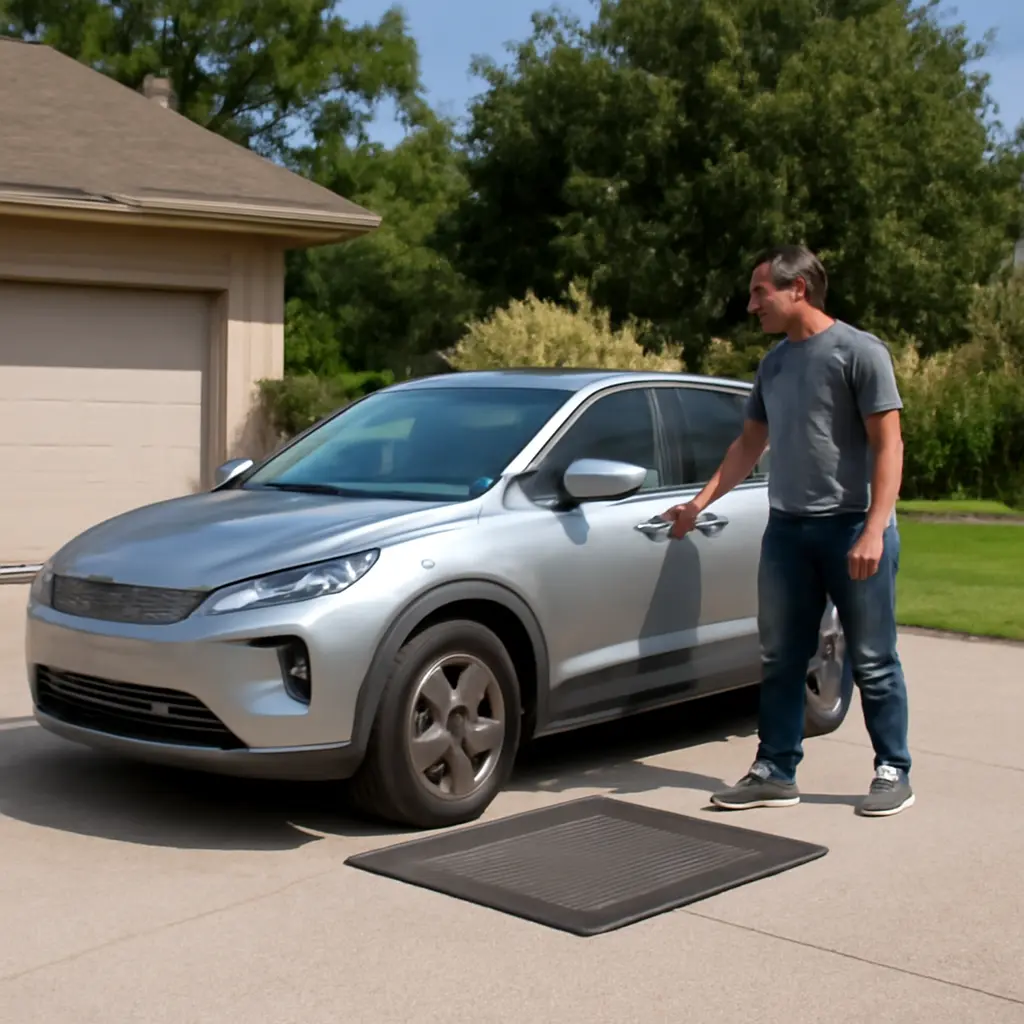
Wireless charging for electric vehicles uses magnetic power transfer across the gap between a ground assembly and a vehicle-mounted receiver. Resonant designs can help accommodate differences in parking position and vehicle clearance. The Society of Automotive Engineers’ SAE J2954 standard specifies interoperability, electromagnetic compatibility, performance, and safety requirements for light-duty plug-in electric vehicles using wireless power transfer. Standardization is important because vehicle charging involves substantially higher power than charging a phone and must work reliably across compatible equipment.
Industrial applications can include automated guided vehicles and equipment that charges while parked or moving along a defined route. These systems can reduce connector wear and enable automated operation, but they require purpose-built infrastructure and careful engineering. Resonant charging is therefore best understood as a flexible magnetic approach—not a universal replacement for cables or conventional inductive pads.
Radio-Frequency Charging: The Longer-Range, Low-Power Attribute
Radio-frequency charging transfers energy as electromagnetic radio waves. A transmitter broadcasts RF energy, and a receiving antenna captures some of it; a rectifier then converts the received signal into direct current. Unlike inductive and resonant systems, RF power transfer can work over greater distances and does not require the receiver to sit directly on a charging pad. However, the energy available at the receiver falls with distance and depends on transmitter power, antenna design, orientation, obstructions, and regulatory limits.
RF charging is generally most appropriate for devices with very low energy needs, such as sensors that can operate intermittently or store energy between transmissions. It is not usually comparable to a phone charging pad in speed or delivered power. The Federal Communications Commission regulates radio transmitters in the United States, while exposure guidance from organizations such as the International Commission on Non-Ionizing Radiation Protection is relevant to evaluating radio-frequency fields.
RF Energy Harvesting for Sensors
RF energy harvesting collects ambient or deliberately transmitted radio-frequency energy and converts it into a small electrical supply. A sensor may use that energy to take a measurement, send a short data packet, or charge a small storage component. This can reduce battery replacements in hard-to-reach locations, including building infrastructure, industrial monitoring, and some Internet of Things deployments.
The key constraint is the low power density typically available at the receiver, especially at a distance. A practical system must match its energy budget to the sensor’s workload: it may transmit occasionally rather than continuously, use a low-power radio, or combine RF harvesting with a battery or capacitor. RF charging is thus valuable for enabling small, low-duty-cycle devices, not for rapidly replenishing large batteries.
Safety, Regulation, and Real-World Limits
RF wireless power systems must comply with applicable transmitter rules and exposure requirements. The Federal Communications Commission’s equipment authorization framework applies to many radio transmitters marketed in the United States, while ICNIRP publishes guidelines for limiting exposure to electromagnetic fields. Compliance depends on the specific frequency, output, antenna, distance, and operating environment; a general claim that a technology is “safe” or “unsafe” cannot replace assessment of a particular product.
RF power transfer is especially sensitive to real-world conditions. Walls, people, metal objects, and antenna orientation can change the received signal, while legal limits restrict how much power a transmitter may radiate. These constraints explain why RF systems are promising for low-power sensors but are not currently the typical choice for fast consumer-device charging.
Choosing Among the Three Wireless Charging Types
The right approach depends on the device’s power demand and how users will position it. Inductive charging is the practical default for a phone or wearable placed on a pad. Resonant charging is attractive when greater placement flexibility or engineered vehicle and industrial integration is needed. RF charging is a candidate when a device needs very little energy and must operate without a direct charging dock.
- Choose inductive charging for close-range, standardized charging of phones, earbuds, watches, and sealed small devices.
- Consider resonant charging for applications that benefit from more tolerant alignment, larger charging zones, or purpose-built vehicle and industrial systems.
- Consider RF charging for low-power sensors and devices where occasional energy harvesting is more important than rapid battery charging.
Efficiency should also be part of the decision. Every wireless system has losses in power conversion and energy transfer, and losses may rise with poor alignment or greater distance. A charger’s rated output is not the same as the power ultimately stored in a battery. Buyers can improve results by checking compatibility and certification, using the recommended power adapter, keeping charging surfaces unobstructed, and following the device maker’s guidance on heat and cases.
Conclusion: Matching Wireless Charging to the Job
Inductive charging is the established near-field option for everyday consumer devices; resonant charging extends magnetic power transfer toward more flexible positioning and specialized vehicle or industrial applications; and RF charging enables longer-range delivery of small amounts of energy for low-power devices. The technologies share the goal of avoiding a direct plug connection, but they differ substantially in range, power, alignment requirements, efficiency, and infrastructure.
As wireless power becomes more common, standards, safety testing, efficient design, and honest performance claims will be essential. Before choosing a product, check its charging standard and certified power level, then match the technology to the device’s actual energy needs. For further reading, consult the Wireless Power Consortium’s Qi and Qi2 materials, IEC wireless power transfer standards, and SAE J2954 for vehicle systems.
Sources: U.S. Department of Energy, Wireless Power Transfer, https://www.energy.gov/; Wireless Power Consortium, Qi and Qi2 Wireless Charging Standards, https://www.wirelesspowerconsortium.com/; International Electrotechnical Commission, IEC 61980 Series: Electric Vehicle Wireless Power Transfer (WPT) Systems, https://www.iec.ch/; André Kurs et al., “Wireless Power Transfer via Strongly Coupled Magnetic Resonances,” Science, 2007, https://www.science.org/doi/10.1126/science.1143254; Society of Automotive Engineers, SAE J2954: Wireless Power Transfer for Light-Duty Plug-In/Electric Vehicles and Alignment Methodology, https://www.sae.org/standards/content/j2954_202010/; Federal Communications Commission, Equipment Authorization, https://www.fcc.gov/engineering-technology/laboratory-division/general/equipment-authorization; International Commission on Non-Ionizing Radiation Protection, Guidelines for Limiting Exposure to Electromagnetic Fields, https://www.icnirp.org/; U.S. Energy Information Administration, “Electricity Use in Data Centers Is Growing Rapidly,” https://www.eia.gov/todayinenergy/detail.php?id=61483.